Showing posts with label Kanyakumari. Show all posts

Thursday, 11 June 2009

VATTAKOTAI(my favorite picnic spot)


Entrance to the fort


********** Vattakottai Fort or 'Circular Fort' is a seaside fort near Kanyakumari, the southern tip of India. It was built in the 18th century as a coastal defence-fortification and barracks in the erstwhile Travancore kingdom.

**********It was constructed under the supervision of Captain Eustachius De Lannoy, an ex-Dutch naval officer of the VOC, who became commander of the Travancore army (the very army that defeated him in the Battle of Colachel) in the 18th century, after he earned the trust of the Travancore King Marthanda Varma. De Lannoy constructed Vattakottai, as part of the defence-fortifications he undertook throughout Travancore.

**********The fort is made of granite blocks and, today, a part of the fort extends into the sea. It is a protected site under the Indian archaeological department. A major renovation of the fort was undertaken recently by the department, and the site is now a popular tourist spot.
Vattakottai Fort commands a picturesque view of both the sea on one side, and the hills (Wester Ghjats)on the other . Another interesting feature near the site is a beach of black sands. It is about 7 km from Kanyakumari town.

History of my District

````````````Kanyakumari has a rich and ancient history. It also bears Christian, Jain and Muslim influence. It is believed that when St Thomas (one of the 12 apostles of Jesus) came to Indian subcontinent in 52 AD a church was established in Kanyakumari area.
````````````It is proved that great Greek philosophers like Erosthenes, Ptolemy and Pliny had been to Kanyakumari. It also finds mention in the Periplus written somewhere around 800 AD by Arrian a Greek man of letters. Similarly, Jainism and Islam have also left their imprints on this place and have considerably contributed to the architectural wealth and literary heritage of the region.
````````````The area of Kanyakumari had seen the rule of Cholas, Cheras, Pandyas, Vijayanagara Kings, the Nayaks , Venad Kings to Dutch and then British interference.
Rise of Venad Chieftains
````````````Gradually the Chola Empire became weak with the rise of of Hoysalas and western Chalukyas. The Venad Chieftains descendants of Chera’s seized opportunity and gradually established a firm grip on the areas now under modern Tamil Nadu. By 1115 AD the Venad Kings under Veera Kerala Varma and his successors achieved complete succession.
````````````In 1609 AD Viswanatha Nayak of Madurai captured Kanyakumari. Afterwards there was no real threat to Venad Kings. Kanyakumari thus became an integral part of the Venad Empire with the capital at Padmanabhapuram. King Anizham Thirunal Marthanda Varma(1729-1758) of Venad dynasty formed Travancore ( Modern Kerala) by extending his domain further north up to Aluva. Kanyakumari thus came to be known as Southern Travancore. In 1741, King Marthanda Varma another great king from the same dynasty overcame the Dutch East India Company forces at the fiercely fought “Battle of Colachel.”
Kanyakumari under British Supremacy
````````````After Marthanda Varma, the subsequent rulers were very weak and as the British forces were gradually tightening their noose over all Indian Princely states Kanyakumari was also no exception. The British established complete control over Venad Kings and continued till India’s independence in the year 1947. The Kings of Travencore state ruled over Kanyakumari under the overall sovereignty of the British.
Modern Kanyakumari
````````````Travancore became part of the independent Indian Union in 1947 thus the royal reign came to an end. From 1947 to 1956, His Highness Sree Chithira Thirunal, Maharaja of Travancore continued as Rajpramukh of the Travancore-Cochin Union.
````````````In the year 1949, Kanyakumari became a part of the reconstituted Travancore-Cochin Union. The Tamil majority of Kanyakumari was not happy with this. Eventually in 1956 bowing to a mass agitation under the leadership of Thiru M.A. Nesamani Government of India amalgamated Kanyakumari District with Tamil Nadu(then Madras State).

Tuesday, 17 March 2009

Kanyakumari


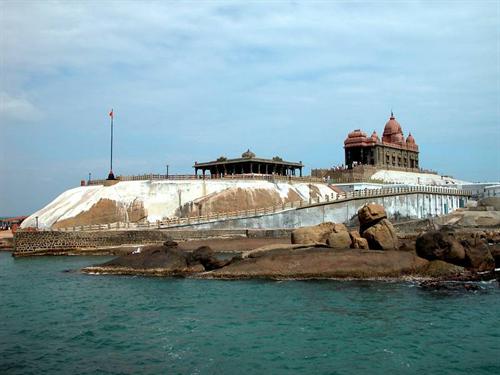
My blog would not complement without a description of my native place. Kanyakumari one of the serene and beautiful district of TamilNadu, is situated at the southern tip of the Indian Peninsula. The district is a land of tourist attractions with many historic and religious sites that are centuries-old and also endowed with great natural beauty, both on the coasts and the mountainous interior. Kanyakumari town is named after the Goddess Kanyakumari Amman. Legend has it that the Goddess Parvati in one of her incarnations as Devi Kanniya, did penance on one of the rocks of this 'land's end' to obtain the hand of Lord Shiva.


The main languages spoken by people of the district are Tamil and Malayalam. English is widely understood in the urban areas. Kanyakumari District, today, tops the state in literacy levels and education. Colleges of higher education are found throughout the district - especially Arts and Sciences colleges and Engineering colleges. The state runs the Kanyakumari Medical College at Asaripallam, near Nagercoil.


Hinduism, Christianity and Islam are the three main religions represented in the district. The distribution of population based on religion is as follows: Hindus - 53.26%, Christians - 43.46%, Muslims - 3.19% and Others - 0.09%.


Kanyakumari District accounts for more than 95% of the production of natural rubber in the state of Tamil Nadu. Rubber is cultivated mainly in the hilly areas (on the western ghats) in the interior, while paddy fields and other crops are mainly found on the plains, near the coast.


Enjoys very pleasant climate and a beautiful landscape. To know more visit Kanyakumari.